Lab: XML Database - Basics - Store and Query XML (optional)
Thursday 12th November 2026
Storing and Querying an XML Document in Elemental
Writing FLWOR Expressions
Joining data togeter
First we will store a single document into Elemental using eXide
Find the file hindawi-example.xml in the provided Exercises folder at: Exercises/samples/hindawi-example.xml
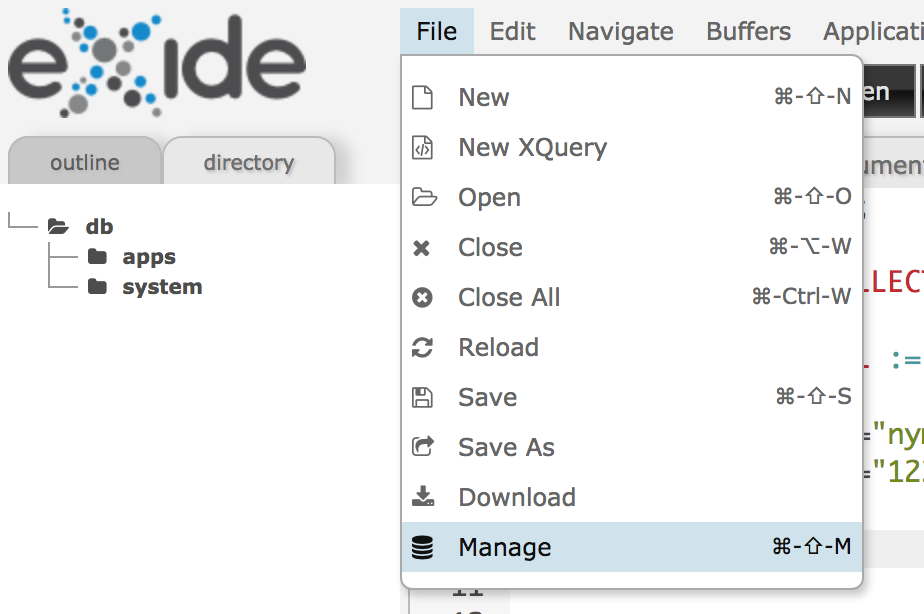
From the File Menu in eXide, enter the DB Manager:
hindawi-example.xml file from your Computer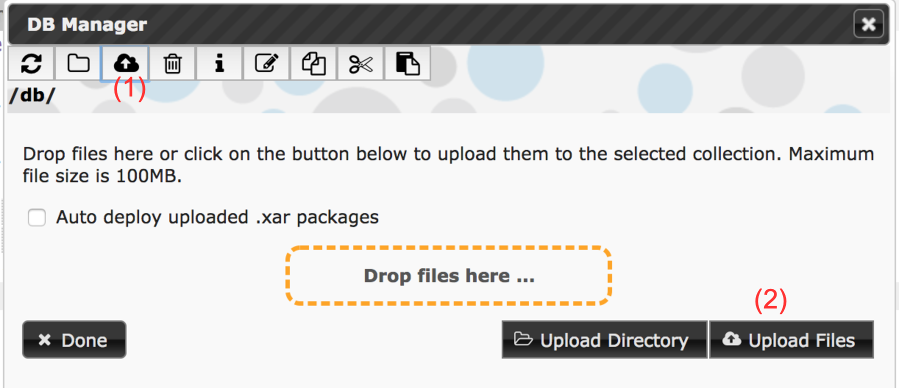
Refresh the Directory side-panel in eXide
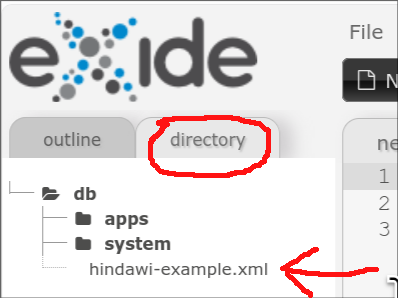
/db/hindawi-example.xml document to open it from the databaseUsing eXide, write an XQuery for the Journal Article
Query /db/hindawi-example.xml
Produce an XML report of the authors names, similar to:
              <authors>
                <author>Priscilla Walmsley</author>
                <author>Adam Retter</author>
                <author>Michael Kay</author>
                <author>Tomos Hillman</author>
              </authors>
Hint: XQuery components you could use include:
For BindingWhere Clausefn:concat function
      <authors>
      {
        for $contrib in //contrib-group/contrib
        where $contrib/@contrib-type eq "author"
        return
          <author>{concat($contrib/name/given-names, " ", $contrib/name/surname)}</author>
      }
      </authors>
Produces the report:
      <authors>
        <author>Bo Zhang</author>
        <author>Wenxu Xie</author>
        <author>Yong Xiang</author>
      </authors>
      <authors>
      {
        for $contrib in //contrib-group/contrib
        where $contrib/@contrib-type eq "author"
        return
          <author>{concat($contrib/name/given-names, " ", $contrib/name/surname)}</author>
      }
      </authors>
For Binding: for each contrib child element present in the //contrib-group element(s), bind each in turn to the variable $contrib
Where Clause: but only where each contrib element (referenced by $contrib) has a contrib-type attribute with the value equal to author
Return Clause: for each thing we have bound, evaluate the next expression
Concat Function: concatenates one or more strings together into a single string
      <authors>
      {
        for $name in doc("/db/hindawi-example.xml")
            //contrib-group/contrib[@contrib-type eq "author"]/name
        return
          <author>{$name/given-names || " " || $name/surname}</author>
      }
      </authors>
Doc Function: retrieves a document using the URI /db/hindawi-example.xml specified, and typically returns its document-node()
Predicate: Only where the context item ( contrib element) has a contrib-type attribute with the value equal to author
String Concatenation Expression: syntactic sugar for fn:concat(a, b)
Using eXide, write an XQuery for the Journal Article
Query /db/hindawi-example.xml
Produce an XML report of the references to articles ordered by year (most recent first) and title:
          <references>
            <article year="1999" doi="12.1234/ab123456a">Why Cat Memes dominate the Internet, and its impact on the psychology of dog owners</article>
            <article year="1995" doi="12.1234/ab123456b">How Dragonfruit developed its Colour</article>
          </references>
Hint: XQuery components you could use include:
Let BindingOrder By Clausexs:integer type constructor
      <references>
      {
        for $cite in doc("/db/hindawi-example.xml")
            //ref[@content-type eq "article"]/nlm-citation
        let $year :=
            if ($cite/year)
            then xs:integer($cite/year)
            else 0
        order by $year descending, $cite/article-title ascending
        return
          <article year="{$year}" doi="{$cite/pub-id[@pub-id-type eq 'doi']}">
          {
            $cite/article-title/text()
          }
          </article>
      }
      </references>
Using eXide, write an XQuery:
Query /db/hindawi-example.xml
From the articles' authors, produce an XML report of the references which were also likely authored by the same people. Similar to:
          <article year="2014" title="Key Observations of Retterpotomus Social Interactions">
            <authors>
              <author surname="Retter" given-names="Adam"/>
            </authors>
            <self-refs>
              <article year="2011" title="Upon the Discovery of The Retterpotomus">
                <author surname="Retter" given-names="A."/>
              </article>
            </self-refs>
          </article>
      let $article := doc("/db/hindawi-example.xml")/article
      let $authors := $article//contrib-group/contrib[@contrib-type eq "author"]/name
      return
        <article year="{$article//pub-date[@pub-type eq 'publication-year']/year}" title="{$article//article-meta//article-title}">
        { $authors ! <author surname="{surname}" given-names="{given-names}"/> }
          <self-refs>
          {
            for $cite in $article
                //ref[ @content-type eq "article"]/nlm-citation[.//surname = $authors/surname]
            return
              <article year="{$cite/year}" title="{$cite/article-title/text()}">
              {
                $cite/person-group[ @person-group-type eq "author"]/name !
                    <author surname="{surname}" given-names="{given-names}"/>
              }
            </article>
          }
          </self-refs>
        </article>
How to store a document into Elemental
How to query a document in Elemental
FLWOR Expressions
Joining data together